Asphalt plant operations rely on consistent, reliable high-temperature heat to keep aggregate drying, bitumen storage,…
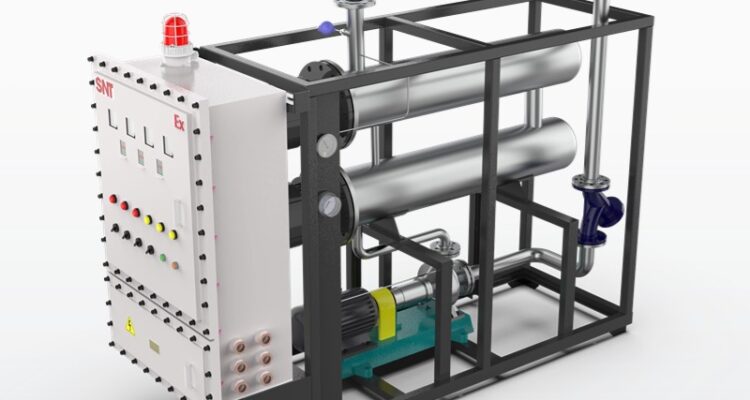
thermal oil heater heat exchanger application
Thermal Oil Heater Heat Exchanger: How They Work and Where They Fit in Industrial Systems
If your plant runs on thermal oil — whether it is mineral oil, synthetic fluid, or a glycol-based heat transfer medium — the heat exchanger is not a peripheral component. It is the engine room of your entire heating loop. A thermal oil heater gets the fluid hot. The heat exchanger puts that heat to work where it matters. Without a properly matched exchanger, your heater runs harder, your energy bill climbs, and your process temperature drifts out of spec faster than you can correct it.
This is not about picking the biggest exchanger you can find. It is about matching the exchanger to your thermal oil system’s flow rate, temperature range, and process demands. Get it wrong and you are burning fuel for no reason.
Why the Heat Exchanger Is the Most Underrated Part of a Thermal Oil System
Most engineers focus on the heater itself — burner size, fuel type, temperature controller. That makes sense. The heater is what gets the oil up to 300°C or 350°C. But the heater is only as good as whatever sits downstream. The heat exchanger is where thermal energy actually transfers from the oil to your process fluid, your mold, your reactor jacket, or your drying drum.
The Energy Transfer Problem Nobody Solves Properly
Here is the core issue: thermal oil has a relatively low specific heat capacity compared to water. It carries less energy per kilogram per degree. That means you need higher flow rates and larger heat transfer surfaces to move the same amount of thermal energy that a water system would handle with half the hardware. Most plants undersize the exchanger for the oil loop, then wonder why the process temperature takes forty-five minutes to stabilize instead of fifteen.
The fouling factor makes it worse. Thermal oil degrades over time. It cracks, it cokes, it leaves carbon deposits on every surface it touches. A heat exchanger that is clean on day one can lose 20 to 30 percent of its heat transfer efficiency within six months if the oil is not managed properly. This is why exchanger selection is not a one-time decision. It is an ongoing maintenance conversation.
Types of Heat Exchangers Used With Thermal Oil Heaters
Not every exchanger design works with every thermal oil application. The choice comes down to pressure, temperature, fouling tendency, and whether you need the process fluid and thermal oil to stay completely separated.
Shell and Tube: The Workhorse for High-Temperature Loops
Shell and tube exchangers dominate thermal oil applications above 200°C. The design is simple: hot oil flows through tubes, process fluid flows around them inside a shell. Or the reverse, depending on which side needs higher pressure containment.
The advantage is durability. Shell and tube units handle pressures up to 40 bar and temperatures well beyond 350°C without deforming. They are also easy to clean mechanically — you can run a brush or a high-pressure water jet through the tubes to remove coke buildup. For plants running continuous cycles at high temperature, this is the default choice.
The downside is size. A shell and tube exchanger for a 500kW thermal oil loop can weigh several tons and take up significant floor space. If your plant is tight on room, this matters.
Plate Heat Exchangers: Compact but Limited
Plate exchangers offer much higher heat transfer efficiency per unit volume. For the same 500kW duty, a plate unit can be 60 to 70 percent smaller than a shell and tube equivalent. That saves space and reduces thermal oil inventory, which means faster startup times and less fluid degradation during idle periods.
But plates have a ceiling. Most gasketed plate exchangers max out around 200°C and 16 bar. Beyond that, you need welded plate designs, which are harder to clean and more expensive to repair. For thermal oil systems operating above 250°C, plates are risky unless you are dealing with a low-fouling synthetic fluid and you have a strict oil filtration program in place.
Spiral Heat Exchangers: The Fouling-Resistant Option
Spiral exchangers use two long metal plates wound into a spiral channel. One channel carries the thermal oil, the other carries the process fluid. The continuous spiral creates high turbulence even at low flow rates, which fights fouling naturally.
This makes spiral exchangers popular in applications where the process fluid is dirty — polymer melts, food-grade syrups, chemical slurries. The oil side stays relatively clean because the spiral geometry does not have dead zones where coke can accumulate. The trade-off is that spirals are difficult to inspect internally. If something goes wrong, you often cannot repair them in the field. You swap the whole unit.
Matching the Exchanger to Your Thermal Oil Heater
Flow Rate and Temperature Delta Drive the Sizing
The heat exchanger duty is calculated from a simple energy balance:
Q = m × Cp × ΔT
Where Q is the heat duty in kW, m is the mass flow rate of the process fluid, Cp is its specific heat, and ΔT is the temperature difference between inlet and outlet. For the oil side, the same Q must be delivered at the oil’s flow rate and temperature drop.
Most designers aim for a 20 to 30°C temperature drop on the oil side. Going wider than that reduces the log mean temperature difference (LMTD), which means you need a larger exchanger to deliver the same duty. Going narrower than 15°C means you are pumping more oil than necessary, which increases pump energy and accelerates oil degradation through shear stress.
The process fluid side should have a temperature approach — the difference between oil outlet and process fluid outlet — of no more than 10°C. If your application demands a closer approach, you need a larger exchanger or a different design. There is no shortcut here.
Material Compatibility Is a Silent Killer
Thermal oil at 300°C is aggressive. It attacks carbon steel over time. The heat exchanger tubes or plates must be stainless steel — typically 316L for mineral oil up to 300°C, and 310S or higher alloys for synthetic fluids above 320°C. Using the wrong material does not cause immediate failure. It causes slow pitting, then leaks, then a catastrophic oil-to-process fluid cross-contamination event that shuts down your line for weeks.
For the process fluid side, material choice depends on what you are heating. Corrosive chemicals need Hastelloy or titanium. Food-grade applications need electropolished 316L with no dead legs. The thermal oil side and the process side often require different alloys, which is why double-walled designs with isolation barriers exist.
Common Mistakes in Thermal Oil Heater Exchanger Selection
Oversizing the Heater, Undersizing the Exchanger
This is the most frequent error. Engineers buy a heater with 20 percent spare capacity “just in case” but spec the exchanger at exactly the calculated duty with zero margin. The result: the heater can produce more heat than the exchanger can reject. Oil temperature climbs past setpoint, the safety valve opens, and you are wasting fuel every single cycle.
The exchanger should always be sized at 110 to 120 percent of the calculated duty. The heater can match that. If the exchanger is the bottleneck, no amount of heater capacity will fix your process temperature.
Ignoring the Oil Degradation Curve
Thermal oil does not last forever. Its bulk temperature, residence time in the heater, and exposure to oxygen all accelerate degradation. A heat exchanger that forces the oil to make multiple passes through the heater to reach target temperature is killing the oil faster than a single-pass design with a properly sized exchanger.
Every pass through the heater adds thermal stress. Minimize passes. Size the exchanger so the oil does its job in one trip through the heater and one trip through the exchanger. This extends oil life by 30 to 40 percent in most plants, which translates directly into lower replacement costs and less downtime.
Forgetting About Startup and Shutdown Cycles
Thermal oil systems do not run at steady state all the time. They heat up from ambient, cool down during maintenance, and sit idle on weekends. During startup, the oil is cold and viscous. Flow rates are low. Heat transfer is poor. If the exchanger was sized only for steady-state duty, it will not deliver enough heat during the first thirty to sixty minutes of operation.
This is why some plants install a bypass line with a smaller auxiliary exchanger for startup. The main exchanger takes over once the oil reaches operating temperature. Without this, your process temperature will drift for the first hour of every shift, and your quality control team will spend the morning chasing outliers.
Related Posts